Overview
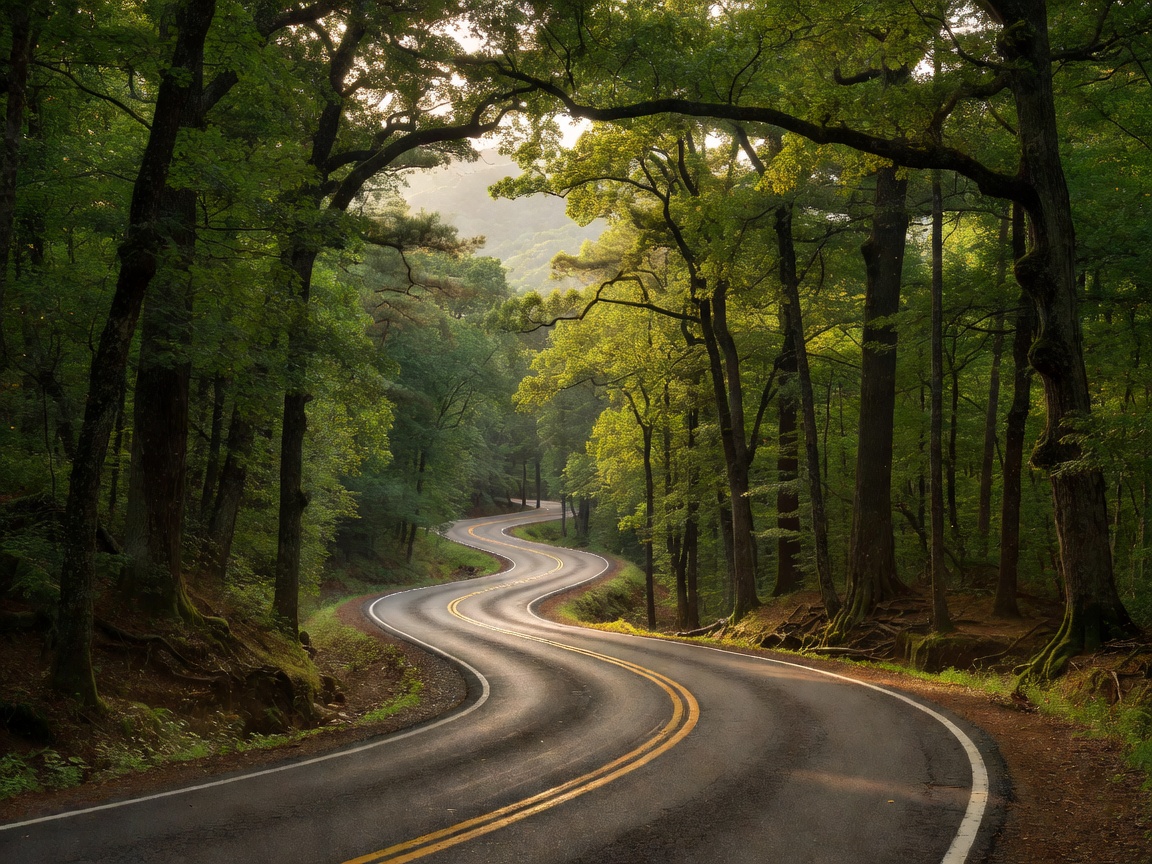
Bordering the Great Smoky Mountains National Park, a small stretch of US Route 129 has achieved mythical status among driving purists. Known as the Tail of the Dragon, this 11-mile segment packs an astonishing 318 curves. Unlike the towering alpine passes of Europe, the Dragon doesn't rely on massive elevation changes or scenic vistas to thrill; its appeal lies in its dense, rhythmic, and continuous lateral loads. You are entirely enveloped by deep forest, restricting sightlines and forcing the driver to rely on intuition and immediate reactions.
The Dragon is unique in its engineering. Many of the corners are heavily cambered, catching the car and allowing for mid-corner speeds that defy the tight radius of the turn. The tarmac is maintained specifically to cater to enthusiast traffic, remaining generally smooth with predictable grip levels, even under the canopy.
Dynamic Character
Rhythm and Flow
The true challenge of the Dragon is rhythm. The corners bleed directly into one another. A late apex on one curve ruins the setup for the next two. This road severely punishes understeer; a car that pushes its nose will quickly fall out of sync with the road's demanding cadence. Front-engine, rear-wheel-drive sports cars with a 50/50 weight distribution shine brightest here, transferring weight fluidly from left to right without overwhelming the outside tires.
Lack of Run-Off
Crucially, there is zero margin for error. The road is flanked by steep embankments on one side and a sheer drop into the forest on the other, lined solidly with mature oak and pine trees. There are no gravel traps. Overcommitting to a blind entry will result in immediate consequences, demanding a driving style that keeps the car well within its grip limits while maintaining momentum.
Key Sectors and Features
While the route is short, enthusiasts have named its distinct sectors. The Gravity Cavity throws the car heavily onto its bump stops before launching it up a sharp rise, testing damper compression limits. The Copperhead Corner features a decreasing radius that tightens aggressively, requiring delicate trail-braking to keep the front axle planted. The constant variation keeps the steering wheel in perpetual motion—drivers rarely find the center point.
- Tire Degradation: The continuous cornering builds immense heat in the tire shoulders. Ensure cold tire pressures are slightly lower than usual to account for the thermal expansion.
- Braking Zones: Unlike downhill mountain passes, brake fade is less of an issue here due to the undulating but generally level nature of the road. However, pad knockback can occur due to the rapid left-right transitions.
- Focus Fatigue: 11 miles doesn't sound long, but 318 corners demand a level of unbroken concentration that can mentally exhaust a driver in under twenty minutes.
Etiquette and Enforcement
The Dragon's fame attracts intense law enforcement. State troopers heavily patrol the area, strictly enforcing the 30 mph speed limit. Furthermore, it is a dual-use road heavily populated by motorcyclists. Staying strictly within the double yellow center lines is paramount—cutting blind corners here is not just poor form, it is extremely dangerous given the oncoming traffic. Pull-offs are frequent; slower traffic is expected to use them to allow faster vehicles to pass safely, maintaining the flow of the road for everyone.